
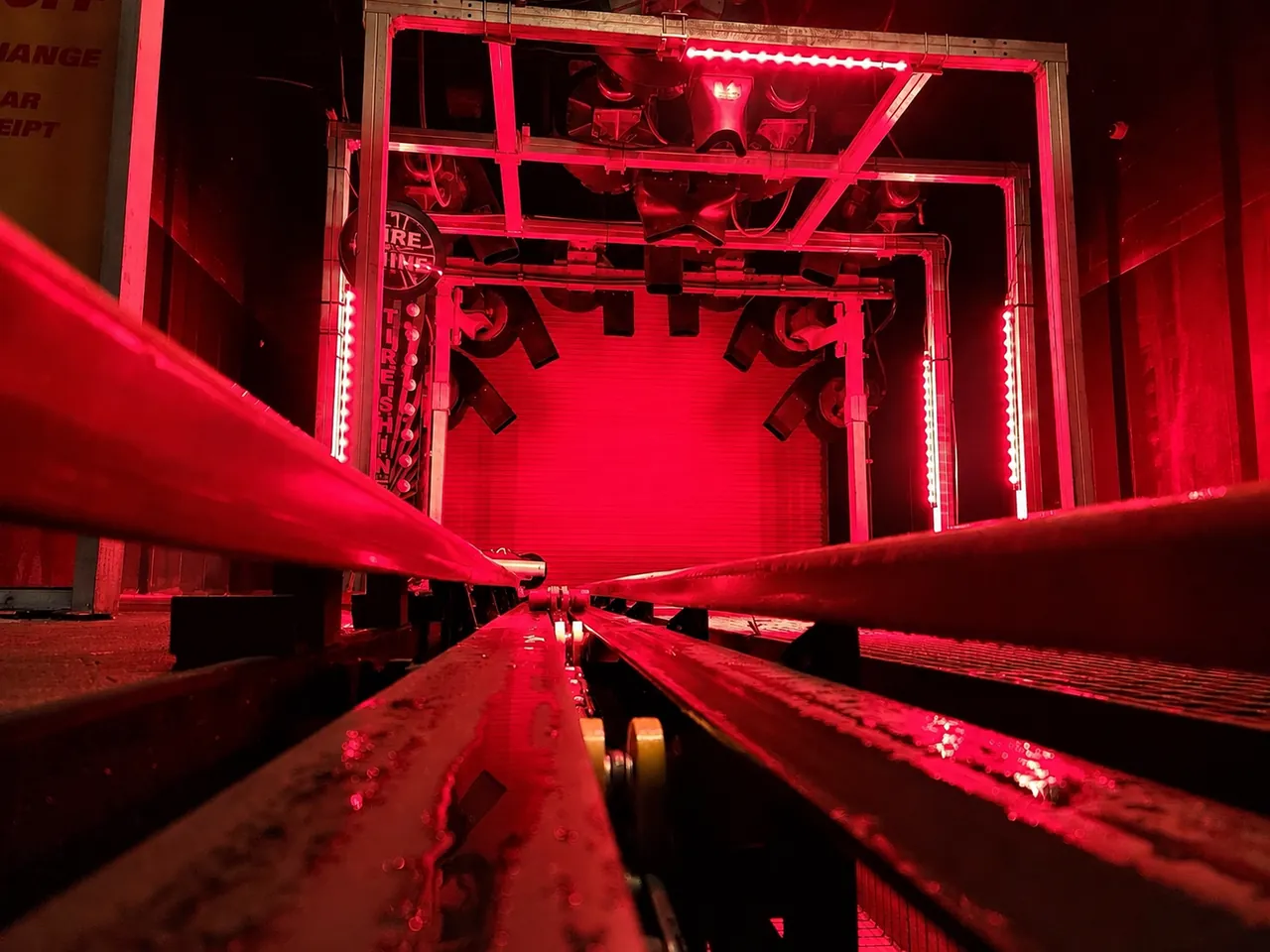
Safety before troubleshooting
Safety first, and this one isn't boilerplate. A conveyor is among the most hazardous systems in a commercial wash. Never enter the tunnel, the trench, or the pit while the conveyor is capable of moving. Never reach into a running conveyor, and never bypass, jumper, or tape over an emergency stop or safety interlock to keep a wash running. Do not open electrical enclosures, adjust chain tension, or enter the trench. Servicing requires qualified, authorized personnel and the site’s energy-isolation and lockout/tagout procedures, including stored energy. An emergency stop is not energy isolation. This article does not cover energized electrical testing. This article is written to help you observe and describe the fault accurately — not to repair it.
A conveyor that keeps stopping is rarely a mystery to the equipment. It's stopping because something told it to, or because something physically won't let it move. The diagnostic job is figuring out which — and the fastest way there is a set of questions you can answer from outside the tunnel.
Possible causes of repeat stoppages fall into six families: sensors and position detection, electrical overload and drive faults, mechanical binding or damage, chain condition and tension, controls and PLC logic, or an environmental condition that only shows up under certain circumstances. Here's how to tell them apart.
Start with three questions
Before touching anything, answer these. They help a technician narrow the fault without unnecessary trial and error. Do not run test vehicles or restart an unsafe conveyor to answer them; use observations already available.
1. Does it stop at the same physical point in the tunnel every time? A stop that repeats at the same location points hard at something at that location — a sensor, a reflector, a damaged section of guide rail, a bad chain link passing a specific point, a worn spot on the track. A stop that happens anywhere points at load, electrical, control logic, or an intermittent connection.
2. Does it stop under load, or empty too? If the conveyor runs clean when empty but stops with cars on it, load is a strong candidate — mechanical drag, a marginal drive, a degrading motor, or an overload sitting near its threshold. If it also stops empty, load is less likely to be the whole story, though it can still contribute: a fault that only escalates under load will often still appear occasionally without it.
3. Is the wash reporting a fault, or just stopping? A displayed fault code gives the technician a useful starting point. A conveyor that stops with no fault indication is a different problem — that's usually a physical interruption of the start signal, a safety device that opened, or a control power issue.
Write the answers down, with the time. Intermittent faults are usually diagnosed from patterns, and the pattern is only available if someone recorded it. A log that says "stopped 4 times Tuesday, all near the dryer, no fault code, only with cars on" is worth more to a technician than any description delivered over the phone from memory.
Sensors and position detection
Sensor and detection faults can cause nuisance stops. Operators can record visible symptoms without adjusting the equipment.
A tunnel is full of devices whose entire job is to tell the controller where cars and rollers are: photo eyes at the entrance and along the tunnel, retroreflective sensors and their reflectors, proximity switches on the roller-up mechanism, treadle plates, limit switches. An incorrect signal can stop the conveyor, depending on the controller and the device’s role.
What makes them lie:
- Contamination. Soap film, wax haze, drying agent, and mineral spotting build a translucent layer on a lens or reflector. The sensor still sees something, which is worse than seeing nothing — it produces intermittent, weather-and-chemistry-dependent faults that seem random.
- Misalignment. Vibration, vehicle contact, and pressure washing walk sensors and reflectors gradually out of position. Marginal alignment can make detection sensitive to vehicle surfaces or changing light conditions.
- Moisture and corrosion at the connector. Wash environments are hostile to terminations. Green corrosion in a connector produces a signal that comes and goes with temperature and vibration.
- Sunlight interference. Low-angle sun into a retroreflective eye can produce a repeatable fault at a particular time of day.
- Physical damage. A sensor a car has clipped may look fine and be pointed somewhere new.
What an operator can safely do: observe from a safe position outside the tunnel. Clean only accessible lenses, reflectors, and sensor faces when trained and authorized, with the equipment in the safe state required by its manual and your site’s energy-control procedure. Never reach into equipment that can move. Look for obvious misalignment, damaged mounts, or a sensor pointed somewhere it clearly shouldn't be. Note which sensor's indicator LED is doing what, if it's visible without opening anything.
What needs a technician: re-aiming and re-ranging sensors to specification, replacing a sensor, opening an enclosure, and anything involving wiring. If the fault returns after cleaning, contamination may be recurring, alignment may be marginal, or the device or wiring may be failing. Report the recurrence for diagnosis.
Electrical overload and drive faults
A protective-device trip or drive fault points toward this family, although safety and control faults can also prevent a restart.
Conveyor drives are protected — by overload relays, breakers, and on VFD-driven systems by the drive's own fault logic. Trips can indicate excessive load, electrical faults, abnormal supply conditions, or temperature problems. Possible causes include:
- Genuine mechanical overload. Something is making the conveyor work harder than it should — a dragging chain, a seized roller, debris in the trench, a binding take-up, a vehicle out of position.
- Motor problems. Bearing wear, winding degradation, or a lost phase on a three-phase supply. A motor running on two phases draws heavily and gets hot fast.
- Drive faults on VFD systems. Overcurrent, overvoltage, undervoltage, and thermal faults each mean something specific, and the drive's fault history is a genuine diagnostic record. Qualified personnel should read it before clearing it.
- A protection device that's failing itself. Overloads and breakers age and can trip below their rating.
Do not reset a tripped overload or breaker just to see if it runs. Have qualified personnel establish the cause and determine that the equipment can be safely reenergized under the manufacturer’s instructions and your site’s procedure. Repeated resets can damage equipment and create a fire risk. Preserve the displayed fault before it is cleared.
What an operator can safely do: note exactly what tripped, what the display said, whether the tunnel was loaded, and how long the conveyor had been running. Look — from outside — for anything obviously binding. Report any burning odor, smoke, or discoloration noticed from a safe position; do not approach, touch, or open equipment to investigate.
Any smell of burning, visible smoke, scorch marks, or discoloration at a motor or enclosure means shut down and call. Do not open the enclosure. Do not reset it.
Mechanical binding and physical obstruction
Sometimes the conveyor stops because it physically can't move, and the electrical system is just reporting that honestly.
- Debris in the trench or track. Wheel weights, hubcaps, trim, broken roller parts, gravel, and mud accumulate. A visual inspection from a safe location can reveal some obstructions; removal belongs to authorized personnel following energy-control procedures.
- A seized or damaged roller. A roller that won't rotate drags rather than rolls, and a bent one binds against the track or the vehicle.
- Guide rail damage. Impact-bent rail creates a pinch point that only binds when a car of the right width and position arrives — which is why the fault seems random.
- A vehicle out of position. Off-track vehicles, oversized tires, lowered vehicles, and aftermarket bodywork all create load the conveyor wasn't designed for.
- Take-up assembly problems. A seized, corroded, or maladjusted take-up lets chain tension drift, and incorrect tension can contribute to mechanical faults.
What an operator can safely do: with the conveyor locked out per your site's procedure, and only if your site's program authorizes staff to do so, visually inspect for obvious debris and damage. Everything else — anything involving reaching into the trench, moving components, or adjusting anything — is technician work.
Chain condition and tension
Chain condition and tension can cause stoppages by different mechanisms.
Too loose, and the chain can skip a sprocket tooth, surge under load, misposition rollers relative to sensors, and produce stops that look like sensor faults. Too tight, and you add continuous load to the drive, accelerate wear on chain, sprockets, and bearings, and push a marginal overload over its threshold.
Elongated, stiff, or unevenly worn chain can move inconsistently and may need repair or replacement rather than a tension adjustment alone. The tell is usually audible and visual before it's electrical: a rhythmic noise, uneven roller travel, or a surge-and-catch motion.
Chain tension is a measured adjustment against your equipment's specification, done on a locked-out machine. It is not an eyeball job, and it is not an operator task. If your conveyor's stopping pattern is accompanied by unusual noise or visibly uneven movement, that's the finding to report.
Record unusual chain noise or uneven roller movement for your conveyor service technician.
Controls, PLC, and communication faults
When the mechanical and sensor stories don't fit, the controls are next.
- A failed PLC input. The sensor is fine; the input that reads it isn't. Symptom: a sensor that tests good but the controller never sees.
- Communication faults. On networked systems, a marginal cable, a loose terminator, or electrical noise — commonly from VFDs sharing a raceway with signal cable — produces dropouts that look like everything and nothing.
- Control power issues. A weak supply, a failing relay, or a loose terminal produces stops with no fault code, because the controller lost the ability to command run rather than deciding to stop.
- Configuration drift. Timers, delays, and sequencing values that were changed — sometimes months ago, sometimes to work around a different problem — and never changed back.
Controller diagnostics are genuinely useful here, and the fault and event history is the record worth preserving. Review it before you clear it, and note anything the display showed when it stopped.
Cabinet access and control-circuit diagnosis belong to qualified personnel under the site’s electrical safety program. Operators should record the externally visible display and avoid opening cabinets or changing control settings.
Intermittent faults: the ones that waste the most time
A fault that recurs through the day but not while the technician is on site is among the most expensive kinds, because it tends to get diagnosed twice.
The pattern helps diagnosis. Build a log with:
- Time of day (catches thermal and sunlight causes)
- Position in the tunnel (catches location-specific causes)
- Loaded or empty, and roughly what kind of vehicle
- Fault code or display state, exactly as shown
- What was running — which arch, whether the dryers had just started, whether another motor started at the same moment
- Weather and temperature, which sounds like overkill until it's the answer
A clear fault log can shorten diagnosis. Report recurring stops promptly; do not keep running unsafe equipment or delay service to collect more examples.
When to stop troubleshooting and call
Shut the wash down and get a technician on site if:
- Anything is burning, smoking, discolored, or unusually hot.
- An overload or breaker has tripped and the cause or safe restart conditions have not been established.
- The conveyor moves when it shouldn't, or won't stop when commanded. This is a safety fault, not a performance fault.
- A safety device has been bypassed, jumpered, or taped — keep the equipment out of service until qualified personnel restore and verify the safety system.
- There's visible chain, roller, sprocket, or rail damage.
- The stoppages are getting more frequent. Escalating frequency warrants diagnosis before the condition worsens.
- You've cleaned the obvious things twice and it came back.
Innovation Car Wash Services provides express tunnel and conveyor service and car wash equipment repair across Florida. Request service or call (352) 890-7147.
Preventing the next one
A maintenance routine can help catch developing causes of conveyor stops. Follow the equipment manual and the site’s safety program when setting intervals:
- Scheduled sensor cleaning and safe visual inspections. Only trained, authorized staff should perform tasks allowed by the site’s procedure. Do not enter the trench or reach into the conveyor.
- A fault log that's actually reviewed. Recurring stops at one sensor warrant investigation; the device, alignment, contamination, or wiring may be involved.
- Chain and roller inspection at manufacturer-specified intervals, with measurements by a qualified technician.
- Take-up and tension checked on a schedule, not after a failure.
- Debris control at the entrance. A lot of trench debris arrives on the cars.
Sites that run preventive maintenance programs tend to find these earlier — before they become a stopped tunnel during peak hours, which is the costliest way to encounter them.