
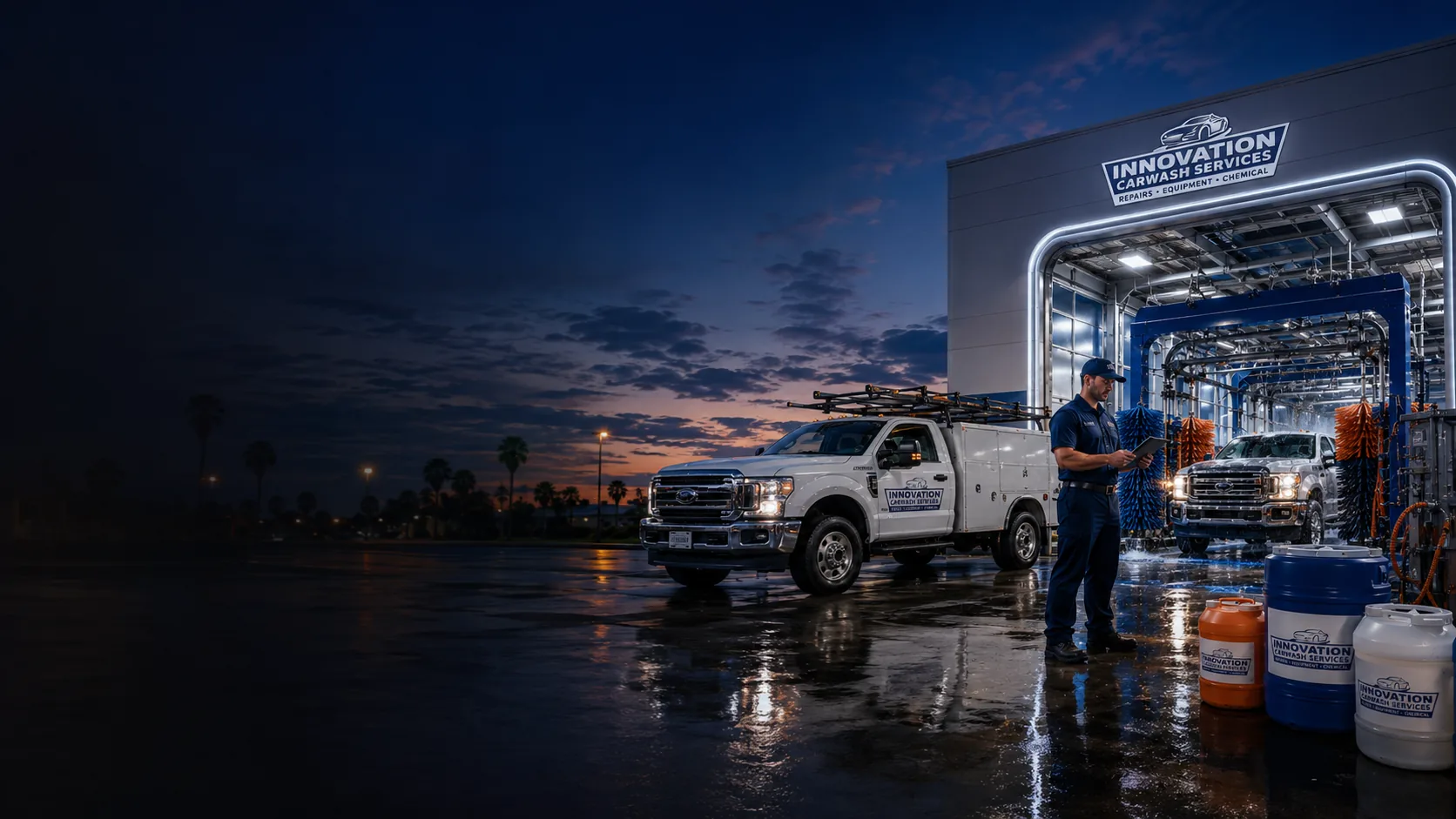
Building a car wash from the ground up is one of the most capital-intensive projects in retail services — and in a growing Florida market, the express tunnel has become the format most new operators build toward. A ground-up tunnel is really an industrial project: heavy mechanical equipment, high-voltage electrical, water and chemical plumbing, and a site laid out so vehicles keep moving. Plan it well and the wash runs smoothly for years; miss a detail and you can be troubleshooting it long after opening day.
This guide walks through what goes into new tunnel car wash construction in Florida — from site planning and equipment selection to permitting, utilities, and long-term maintenance. It's written for operators planning a build, whether you're developing your first express exterior wash or adding a location to a portfolio. Where it's useful, we note where Innovation Car Wash Services fits in: the equipment side of the build, and the service that keeps it running afterward.
Key Takeaways
- Design for throughput first. Tunnel length, stacking lanes, and site flow shape how many vehicles you can comfortably serve at peak.
- Plan for hard and soft costs. Slab, plumbing, and electrical are only part of it — design, engineering, and permitting add up too, and totals vary widely by site.
- Your conveyor is a defining choice. Belt and chain-and-roller systems each have trade-offs; match the choice to your expected volume and layout.
- Florida details matter early. Permitting, utility hookups, drainage, and water-reclamation rules differ by jurisdiction — confirm them locally before you break ground.
- Think past opening day. A maintenance and equipment-service partner helps protect uptime and the investment you just made.
Table of Contents
Planning a New Tunnel Car Wash for Throughput
Consumer habits have shifted toward speed and convenience, and the express tunnel is the format that best delivers a fast, consistent wash. That's why so many new builds are conveyor-driven tunnels rather than older in-bay or self-serve formats. A tunnel is a specialized industrial build — mechanical systems, electrical, and water and chemical plumbing all have to be synchronized so vehicles move through without stopping.
Throughput — how many vehicles the site can process per hour at peak — shapes almost every design decision. From the entrance off the main road, through the stacking lanes, and into the tunnel, the path should be intuitive and unobstructed. Conveyor-driven express tunnels are generally built to handle much higher hourly volume than in-bay automatics, which is a big part of why operators chasing volume gravitate toward express tunnel car wash construction.
Why express tunnels lead new construction
Drivers expect a quick wash that still leaves the car clean and protected. Tunnel length is one of the main levers: a longer tunnel makes room for more wash stages — presoak, high-pressure rinse, foam and protectant applicators, and drying — and for more vehicles on the line at once. Retrofitting an older self-serve or gas-station wash often forces compromises in layout and equipment placement. A ground-up build lets you position blowers, brushes, and arches for the flow you actually want, which is a core reason operators choose ground-up car wash construction in Florida over conversions.
Site selection and feasibility
A strong site starts with honest feasibility work. Operators often evaluate traffic patterns, visibility, ease of entry and exit, competition, and available land before committing. Stacking capacity matters — you need room to queue cars without backing traffic onto public roads — as does space for vacuum stalls to absorb post-wash volume. Parcels near busy commuter corridors tend to be attractive for high-volume tunnels. A feasibility study early on helps surface zoning, drainage, and access constraints before you're committed to hard costs, and local market data matters far more here than any national average.
Ground-Up Site Planning: The Core Components
Once a site pencils out, planning shifts to the physical build — and it helps to separate hard costs from soft costs. Hard costs are the tangible bones of the facility: the reinforced slab, specialized plumbing for water and chemicals, and the electrical service that powers pumps, motors, and blowers. Soft costs are the ones that surprise first-time operators — architecture and engineering, environmental studies, and Florida permitting. Both categories vary widely from one site to the next, so treat any rule-of-thumb figure with caution and build a budget around your specific parcel and scope.
One decision worth making early is electrical capacity. Sizing panels and conduit for future equipment — additional arches, upgraded blowers, more chemical dosing — is far cheaper during construction than retrofitting later.
Structure and building materials
Masonry offers durability, while glass-and-steel frontage can add curb appeal and let passing drivers see the wash in action. Whatever you choose, a Florida structure has to stand up to hurricanes, heat, and humidity, and it needs proper ventilation to protect sensitive electronics. Lighting and signage do real marketing work here — the building is often your most visible advertisement to the traffic going by.
Underground infrastructure: plumbing and water reclaim
The tunnel floor and trench design are among the most important — and least forgiving — parts of the build. Slopes have to move water and sludge toward the right pits; get it wrong and you invite pooling, odors, and premature corrosion. Many Florida car washes use water-reclamation systems to recycle wash and rinse water, which can lower utility use and support environmental compliance. Requirements around reclaim, discharge, and oil-water separation vary, so confirm what applies to your project with the Florida Department of Environmental Protection and your local jurisdiction before construction. Getting the underground work right the first time avoids expensive rework later.
Tunnel Equipment: Conveyors, Arches & POS
The equipment inside the tunnel is where a build becomes a car wash — and it's the part Innovation Car Wash Services focuses on as part of its express tunnel and conveyor car wash service. From the entry conveyor to the final dryer pass, these systems have to be selected, installed, connected, and calibrated to work together on every cycle.
Conveyor systems
Belt or chain-and-roller conveyors, rollers, chains, and drives — the backbone that moves every vehicle through the tunnel.
Controls & electrical
Controllers, PLCs, relays, sensors, and wiring that sequence each wash function in order.
Pump stations
High-pressure pumps, motors, and the plumbing that power presoak, wash, and rinse.
Chemical systems
Dosing, dilution, and delivery equipment for detergents, protectants, and drying agents.
Arches & applicators
Wash arches, foamers, and applicators that apply presoak, foam, protectant, and rinse.
Dryers & blowers
Blowers and dryers positioned to finish vehicles clean and dry at tunnel speed.
POS & pay stations
Entry terminals, pay stations, and point-of-sale that ring up every car and feed the tunnel.
Sensors & safety
Photo eyes, safety stops, and the supporting site equipment a tunnel relies on.
Choosing a conveyor
The conveyor is often the most consequential hardware decision in a tunnel build. Chain-and-roller systems have long been the industry workhorse — durable and straightforward to maintain. Wide-belt systems, which let drivers pull straight on without lining wheels up on a track, can make loading easier for a broad mix of customers. Either way, choose equipment rated for the duty cycle you expect so it holds up through busy periods, and lay the tunnel out with room for proper chemical dwell time and drying. Careful car wash conveyor installation and alignment at this stage pays off for the life of the site.
Arches, applicators, and drying
Behind the scenes, precise chemical dosing keeps results consistent and controls product cost — too little and the finish suffers, too much and you're wasting chemical. Ceramic and tire-shine applicators have become popular ways to add wash tiers and lift the average ticket. Blower placement is its own small science: angle and distance determine whether cars leave dry at conveyor speed. Dialing in that air-to-water balance is part of tunnel car wash equipment installation and startup — and it's easier when the team setting it up is also the team that services it.
POS and pay-station installation
Friction at the entrance quietly caps throughput, so pay-station speed matters. Many operators evaluate license plate recognition (LPR) to identify members and open the gate without the driver stopping — a common backbone for membership and subscription programs, which are an important recurring-revenue stream for many washes. Innovation handles car wash POS installation and pay-station setup as part of new-build equipment work, connecting the entrance to the rest of the tunnel so the line stays fed.
The Florida Construction Process
Florida adds its own wrinkles to a build. Humidity, sudden storms, and a high water table can complicate trenching and slow a schedule, and permitting varies from county to county. Utility coordination is a common source of delay — securing the electrical service for blowers and conveyor motors, plus high-capacity water, needs to start early so activation doesn't hold up your opening. Working with people who know the local landscape helps keep the timeline realistic.
Permitting and utilities
Drainage and water-handling rules are taken seriously across Florida to protect lakes, aquifers, and other water bodies, and the specifics differ by jurisdiction. Expect to address water-use permitting, reclaim and discharge handling, setback and landscape-buffer requirements, and — given the state's high water table — proper dewatering during trenching. Confirm current requirements with your local building department and the appropriate state agencies before breaking ground; skipping this step is a common cause of failed inspections and rework.
A typical construction timeline
Most ground-up builds move through three broad phases:
- Site clearing and underground utilities — laying high-pressure lines, chemical conduit, and electrical feeds.
- Foundation and tunnel trenching — pouring the slab and setting trenches so the conveyor sits level and the floor drains correctly.
- Equipment installation, POS setup, and chemical calibration — turning the structural shell into a working wash.
Timelines vary with permitting, utilities, weather, and site conditions, so treat any single number as a rough guide rather than a promise. Innovation's role sits in that third phase and beyond — installing, connecting, and starting up the equipment, then keeping it running. Because that work depends on the trades ahead of it, we coordinate the equipment side with your contractor and other vendors rather than setting the overall schedule.
Partnering with Innovation Car Wash Services
Choosing who sets up and services your equipment is a decision that outlasts the build. A build-only contractor hands over the keys and moves on; when a conveyor motor seizes or a chemical injector fails during a Saturday rush, you're left finding help on your own. Innovation Car Wash Services works the other side of that equation — we install the wash equipment and then stay to service it, so the same people who set it up are the ones who know it when something needs attention.
What we handle — and what we don't
To be clear about scope: Innovation is not a general contractor or construction company. We don't handle permitting, civil work, concrete, plumbing, or building construction — that's your licensed contractor's world. What we do is the equipment that goes inside the wash. On a new tunnel build, that means new-build equipment support — setting up and connecting conveyor-related equipment, pump stations, controls, arches and applicators, dryers and blowers, chemical systems, and POS and pay stations, then helping bring the site up at startup.
Our approach to new tunnel builds
We work brand-agnostically across tunnel, express, in-bay, and self-serve formats, setting equipment up the way it needs to run rather than just bolting it to the floor. Because we repair and maintain this same equipment every day across Florida, we bring that troubleshooting perspective to installation and startup — the goal being a site that opens ready to wash and stays that way. We also support upgrades and replacements as an existing site grows.
Beyond the build: maintenance and chemical support
Opening day is the start, not the finish. From the moment equipment is installed, we can set up preventive maintenance to catch wear on rollers, seals, and blowers before it becomes downtime, and we handle commercial car wash equipment repair when something fails. Our managed chemical system delivery keeps soaps, protectants, and drying agents stocked so wash quality stays consistent. A well-planned site plus steady maintenance is what helps reduce downtime over the long run — no one can promise a wash never goes down, but the combination stacks the odds in your favor.
Innovation supports commercial car wash operators across Florida — from our Orlando-based team out to sites throughout the state. Whether you run a single express tunnel or a portfolio of locations, you get one partner for the equipment side of the business. See our Florida service area.